Video Games as Emotional Simulators
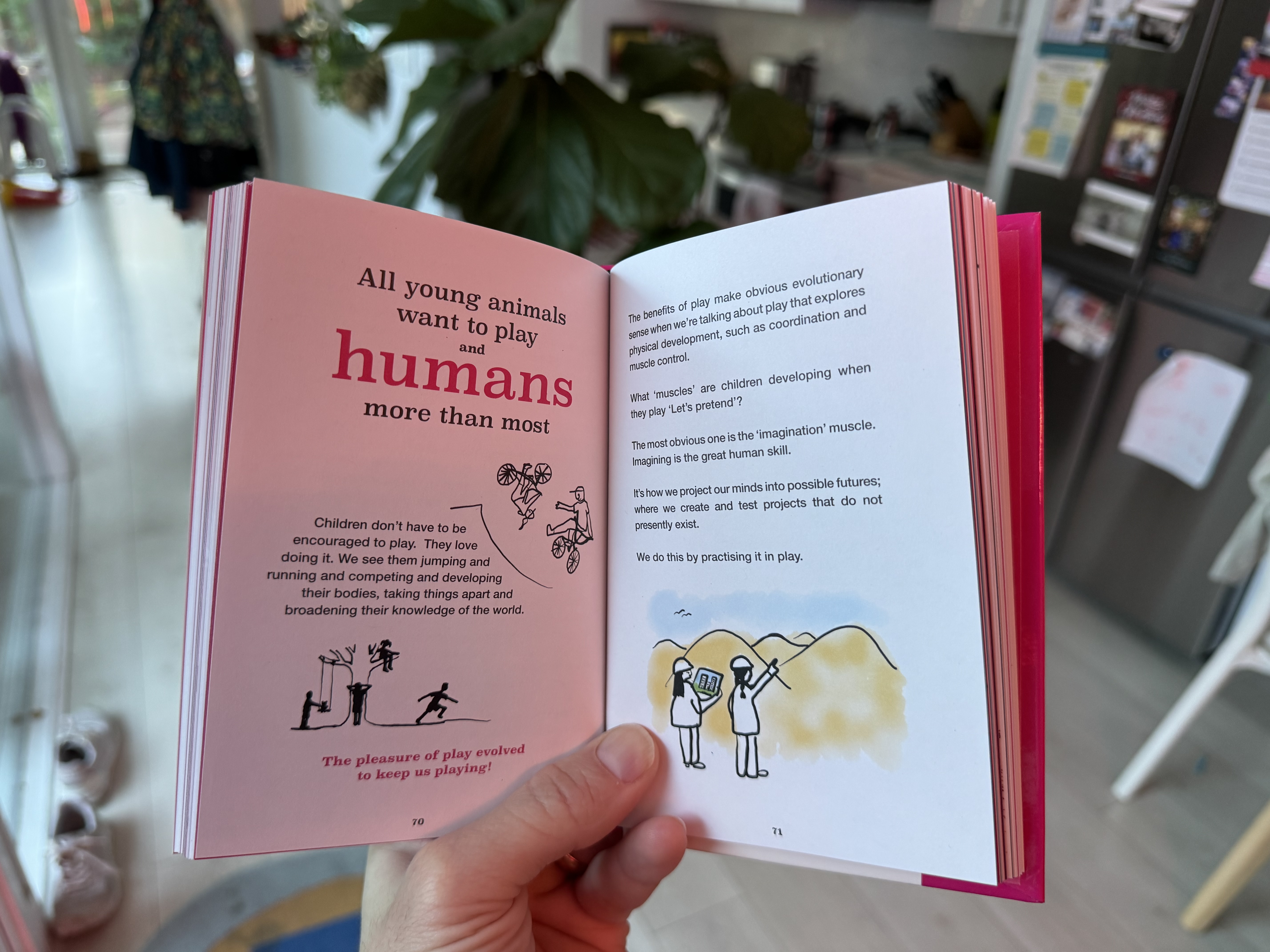
Over the holidays, my aunt Kim and uncle Geoff gifted me Brian Eno’s new book, What Art Does (co-authored with artist Bette Adriaanse.) They’re both musicians, so of course they’d share this.
welp, I read it in one sitting. one idea keeps echoing: ✨art is a simulator ✨ — art creates safe spaces where we can feel on purpose.
Eno’s argument: art offers “a safe place to have quite extreme and rather dangerous feelings.” The reason we can do that? We know we can switch it off. Like a flight simulator — you can crash and walk away laughing 🛟🫀
He’s talking about paintings, plays, radio dramas, fashion, hair styles, and even video games… and IMO — digital games may be the most powerful version of this we’ve ever built 🤯
Watching my daughter rehearse who she wants to be
Over the break, my almost 8yo got into the Hogwarts Legacy game. Watching her play was fascinating… not the spells or the quests, but her dialogue choices 👀
Like most role playing games, you’re constantly prompted: how do you want to respond?? kind or sarcastic? brave or cautious? vengeful or forgiving?
I watched her try on different stances. She’d pick the snarky option, see how it landed, then reload and try the compassionate one. Back and forth. Experimenting. She was practicing (rehearsing??) how it feels to be a certain kind of person, who she wanted to be 🪄🧠
The research backs this up
This “games as a safe space” idea has legit evidence behind it 🤓
Empathy training that actually changes the brain
A 2018 study from UW-Madison, published in npj Science of Learning (a Nature journal), looked at middle schoolers who played an empathy-focused game called “Crystals of Kaydor” for just two weeks.
The game has players interact with aliens on a distant planet. The aliens speak a different language, but their facial expressions are human-like, so players have to read emotions and build rapport to progress.
The results? Kids who played the empathy game showed increased empathic accuracy AND measurable changes in brain connectivity, specifically in regions linked to emotion regulation.
Only two weeks, but measurable brain changes.
The lead researcher, Tammi Kral, put it simply: “The realization that these skills are actually trainable with video games is important because they are predictors of emotional well-being and health throughout life.”
Identity exploration through avatars
Another line of research looks at how young people use games to explore identity.
A focus group study of trans and gender diverse youth (ages 11-22) found that participants used video game avatars to “explore, develop, and rehearse their gender identities and expressions”, and that this process supported their psychological well-being.
The researchers noted that games create a “low-stakes environment” where players can try on different versions of themselves before committing to them IRL. Choice-based games were especially powerful because they gave players autonomy and made their decisions feel meaningful.
This maps directly to what I watched my daughter doing in Hogwarts Legacy. She wasn’t escaping reality — she was using the game as a rehearsal space for figuring out who she wants to be.
What this means for parents
So here’s what I’ve been sitting with:
When your kid feels guilt over a choice they made, mourns a character, or gets frustrated after a tough loss… they’re not wasting time. They’re working something out.
The game is doing what Eno says all art does: giving them a safe container to feel big feelings — so they can recognize and handle them in the real world.
The better question is: who’s helping them process it afterward?
You can be that person. Even just watching and asking curious questions does wonders:
- “How did that choice feel?”
- “Would you do it differently next time?”
- “What kind of character are you trying to be?”
The game is the simulator, but you’re there to help them make sense of what they felt.
Further reading
- 📖 What Art Does: An Unfinished Theory by Brian Eno and Bette A.
- 🧠 Neural correlates of video game empathy training in adolescents — Kral et al. (2018), npj Science of Learning
- 💞 Playing prosocial video games increases empathy and decreases schadenfreude — Greitemeyer et al. (2010), Emotion
- 🧝 The Ideal Elf: Identity Exploration in World of Warcraft — Bessière et al. (2007), CyberPsychology & Behavior
- 🪞 Presenting identity in a virtual world through avatar appearances — Neustaedter & Fedorovskaya (2009), Graphics Interface
- 🎮 If you’re parenting through video games and want scripts for moments like this, that’s what we’re building at Coplay Club.